Information Monopoly: How the Printing Press, Telegraph, and Internet Shattered Power
History12 min
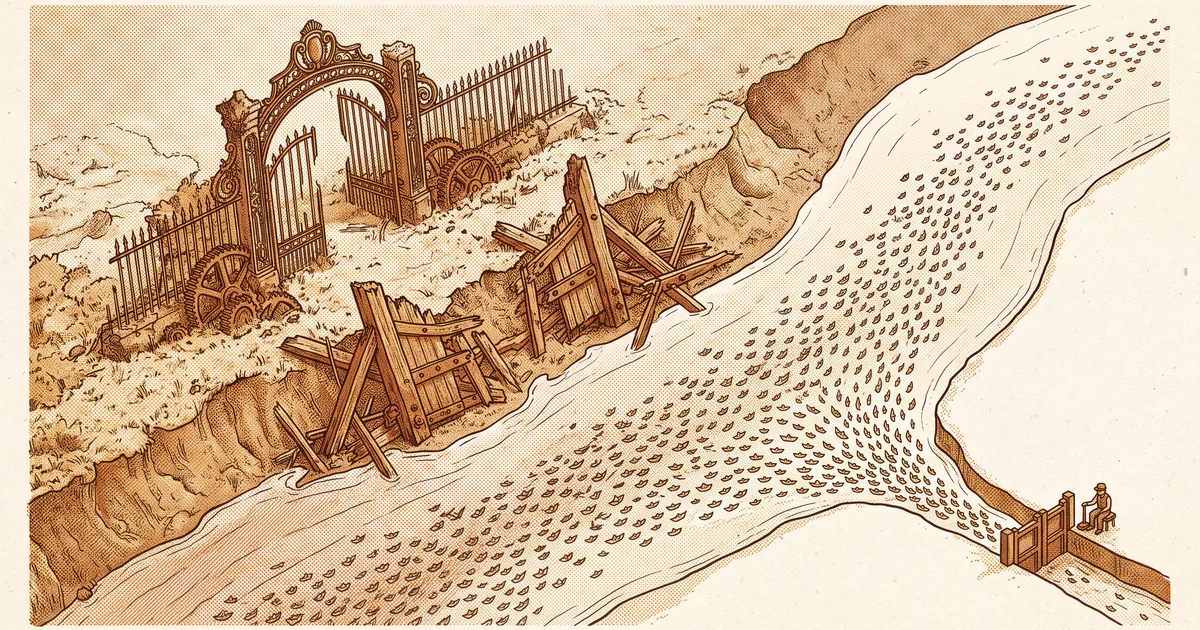
The comfortable story about information technology goes like this. Someone makes it cheaper to copy or move words, the gatekeepers lose their grip, power spreads out, and ordinary people get a voice they did not have before. Printing broke the Church, the telegraph broke distance, the internet broke the media. It is a satisfying story, and I think it’s half of one, and the less important half.
Every one of these revolutions did shatter an existing monopoly. Every one of them then built a new monopoly, usually within a single working lifetime, and usually at the exact layer where the new technology had a natural bottleneck. The title of this piece says the press, the telegraph and the internet shattered power. They did. What they didn’t do was keep it shattered.
§The press broke a monopoly on copying, not on authority
Before movable type in Europe, copying a book was skilled labour, and the institutions with the labour, the monasteries and universities, decided what got copied. Gutenberg’s Bible, finished in Mainz around 1455, came out in about 180 copies, some on paper and some on vellum. Forty-nine survived into the twentieth century.[1] A hundred and eighty is not a mass medium. What changed was the slope: once the type was set, the next copy cost paper and pressman’s time, and within two generations there were presses across the German-speaking world.
That made Martin Luther possible as a phenomenon, not just as a theologian. Until 1518 most of his writing appeared in Latin, for other scholars. From 1518 the large majority appeared in German, for lay readers, in short works that printers reprinted again and again because they sold. Count editions, reprints included, and his lead over every other evangelical writer between 1518 and 1525 is overwhelming.[2] Luther and his printers understood something a modern growth team would recognise at once: the unit is the pamphlet, not the book, and you win on frequency and reprints.
The causal claim is where people overreach, and I want to be careful with it. “The printing press caused the Reformation” is too strong, and “the printing press caused the wars of religion” is much too strong. Those wars had dynastic, fiscal and territorial causes that no amount of pamphleteering explains. The defensible claim is narrower and still striking. Jared Rubin used a city’s distance from Mainz as an instrument for how early it got a press. He found that cities with at least one press by 1500 were at least 29 percentage points more likely to be Protestant by 1600.[3] Print didn’t make people Protestant. It made the movement very hard to contain, because suppressing it now meant finding every press and every reprint, not burning one manuscript.
And then the old powers rebuilt the gate. Rome published its Index of Prohibited Books in 1559 and a revised one in 1564. Catholic territories already had local lists before that. England took a more elegant route. In 1557 the Crown chartered the Stationers’ Company and gave it a monopoly over book production. Members registered titles, nobody else could print a registered title, and the Company could seize offending books. The state did not need to censor every press if it could license a cartel of printers to censor for it.[4] That monopoly lapsed in 1695. The word copyright itself comes out of the Stationers’ register, the right to copy a title the guild had entered. Parliament’s Statute of Anne in 1710 then moved that right from printers to authors. The thing that now protects writers started life as a censorship deal between a monarchy and a trade guild.
§The telegraph was a single wire, and whoever owned the wire won
Samuel Morse sent “What hath God wrought” from Washington to Baltimore on 24 May 1844. For the first time, information moved faster than the thing it described. What followed was a scramble of rival lines and regional companies. Western Union itself was born in 1856 out of a merger of two of them. The scramble didn’t last.
By 1864 Western Union was one of three serious national players. In 1866 it absorbed the other two, the American Telegraph Company and the United States Telegraph Company, and came out with what historians call a virtual monopoly. The next year it had 2,600 offices and 85,000 miles of wire carrying 5.9 million messages. By 1890 it had 19,400 offices, 679,000 miles of wire and 56 million messages a year.[5] Jay Gould took control of it through a merger in 1881.
The engineering detail that explains this matters more than the financiers. A telegraph line carries one message at a time. It’s a channel, not a commons. Menahem Blondheim’s history of the wire services makes the point that the telegraph looked like a great equaliser, a way for any town paper to get news as fast as New York. It did the opposite. Whoever controlled the line controlled what passed over it and in what order.[6]
So the news business consolidated around the wire. The New York Associated Press, which already dominated the European news coming into the port of New York, struck an alliance with Western Union after the Civil War. Blondheim describes it as symbiotic: the news cartel needed the wire, and the wire company needed the biggest customer in news. He calls the result a news monopoly. It was opaque enough that, in his account, the AP could cultivate a reputation for neutrality while its coverage of the disputed 1876 election leaned towards Rutherford B. Hayes.[6] That is a Victorian story about platform neutrality, and it reads uncomfortably well today.
The telephone repeated the pattern a generation later. Independent phone companies grew up to compete with Bell, and AT&T’s answer was to buy them or leave them stranded off its long-distance network. In 1913, under antitrust pressure, the company made the Kingsbury Commitment: it sold its roughly $30 million stake in Western Union, let independents interconnect with its long-distance lines, and agreed to stop buying competitors without regulatory approval.[7] Look at what that bought. AT&T kept the monopoly and agreed to behave. By 1940 the Bell System effectively owned most American telephone service, from the calls to the handsets. A 1956 consent decree followed, then the 1974 antitrust suit, then the January 1982 settlement. On 1 January 1984 the Bell System was cut into seven regional operating companies. After the 1996 Telecommunications Act loosened the rules, most of those pieces merged back together, and the bulk of the old Bell System now sits inside two companies, AT&T and Verizon.
§The Cycle, and what it gets wrong
Tim Wu gave this pattern a name in The Master Switch: the Cycle. A disruptive information technology arrives and breaks a settled order. It then centralises into a closed industry that limits competition and expression. That industry eventually falls, either to the next technology or to the government, and the cycle starts again.[8] Wu’s question in 2010 was whether the internet would go the same way.
I find the Cycle useful and also too tidy, for two reasons.
First, the open phase is shorter than the story implies, and it is not the natural state of the technology. Luther’s German pamphlets took off in 1518, and Rome had a printed Index by 1559. The American telegraph took about twenty years to go from Morse’s demonstration to Western Union’s near-monopoly. Nothing about either technology wanted to be open. Both were open because the incumbents had not yet worked out where the bottleneck was.
Second, the monopolies did not fall by themselves. The Stationers’ monopoly ended when Parliament let the licensing regime lapse in 1695. The Bell System was broken up by a court decree. In each case the decentralising force was not the new technology alone but the new technology plus a state that chose to act. Treating the Cycle as something like weather, a thing that happens to markets, lets everyone off the hook. It is closer to a control problem: without active correction, the system drifts back to concentration, because that is where the economies of scale are.
§The internet moved the bottleneck, it didn’t remove it
The internet was designed in deliberate opposition to the telegraph. The core idea of packet switching and end-to-end design is that the network is dumb: it moves packets and doesn’t care what is in them, and all the intelligence lives at the edges. No single wire to capture, no operator deciding what goes first. As an engineer I think that design is one of the great achievements of the twentieth century, and it did exactly what it promised at the transport layer. The pipes stayed largely neutral and commoditised.
What the design could not do was stop concentration from moving up the stack. If the network won’t give you a chokepoint, you build one at the layer where scale compounds: the search index, the default setting, the app store, the social graph, the ad auction. These have the same property the telegraph line had. Everyone has to pass through them, and the owner sets the order.
In August 2024, after a nine-week trial, a federal judge in Washington ruled that Google is a monopolist, and it has acted as one to maintain its monopoly
. Google had for years handled about 90 percent of US search queries. The remedies, ordered in September 2025, ban Google from exclusive contracts for distributing Search, Chrome, Assistant and the Gemini app. They also require it to make some of its search index and user-interaction data available to rivals and to offer search and search-ad syndication.[9]
Read those remedies next to the Kingsbury Commitment and the rhyme is almost exact. In 1913 the cure for a monopoly network was forced interconnection, letting rivals plug into the lines the incumbent had built. In 2025 the cure for a monopoly index was forced data sharing, letting rivals plug into the index the incumbent had built. More than a century apart, the state reached for the same tool, because the problem had the same shape. The scarce asset is no longer copper wire. It is the accumulated record of what billions of people searched for and clicked on. Data that took decades of being the default to collect can’t be replicated by a better algorithm and a clever start-up.
§Cheap information was never the threat
So I think the hook gets the mechanism backwards. Cheap information is not what scares an incumbent. Incumbents adapt to cheap information all the time. The Stationers turned it into a licensing business, Western Union into a tariff, Google into an auction. What actually threatens them is a moment when nobody yet controls the new bottleneck. Those moments are short. The fight is over who gets to the bottleneck first and whether anyone stops them from sitting on it.
The honest reading of the history is also less bleak than the cynical one. Each re-centralised regime was smaller than the one before, at least in what it could forbid. The Stationers could seize a book. Western Union could only slow a message or favour a customer. Google cannot stop you publishing anything at all. It can only make it hard to find. That is real progress, and it was paid for each time by people who insisted the gate be kept open after it had broken. The press, the wire and the network all spread power around for a while. Keeping it spread has always been a political job, not a technical one.
The same lens works on older systems. A ledger is an information technology too, and the merchants who mastered it built empires out of who knew what and when. That is the subject of The Paper Route. And the guano trade, where a nation’s revenue hung on prices quoted in London, is in The Geopolitics of Guano. I’m also watching the same question surface in AI. Whoever ends up owning the default model, the one sitting between people and what they ask, is building the next switch. I would like us to notice that while the gate is still open, rather than after.
- ^Library of Congress, “The Gutenberg Bible”. The page also points out that movable metal type was in use in Korea nearly a century earlier, which is worth remembering whenever someone calls Gutenberg’s Bible the first printed book.
- ^David Luebke, “The Media Revolution and Reformation”, University of Oregon, which charts the editions of Luther’s works by year and language. For the full argument see Andrew Pettegree, Brand Luther (2015), and Mark U. Edwards, Printing, Propaganda, and Martin Luther (1994).
- ^Jared Rubin, “Printing and Protestants: An Empirical Test of the Role of Printing in the Reformation”, Review of Economics and Statistics 96(2), 2014.
- ^On the charter and the monopoly, see the Stationers’ Company; on Rome, see the Index Librorum Prohibitorum. The Index was not formally abolished until 1966.
- ^Figures from Telegraphy in the United States. Tom Standage’s The Victorian Internet (1998) is the popular history.
- ^Menahem Blondheim, News over the Wires: The Telegraph and the Flow of Public Information in America, 1844–1897 (Harvard, 1994). There is a good synopsis in Cameron Blevins’s reading notes.
- ^Details of the Kingsbury Commitment, the 1956 decree, the 1982 settlement and the reassembly after 1996 are in Bell System.
- ^Tim Wu, The Master Switch: The Rise and Fall of Information Empires (Knopf, 2010). The summary of the Cycle follows Michael J. Faris’s review. My objections are my own.
- ^US Department of Justice, “Department of Justice Wins Significant Remedies Against Google”, 2 September 2025. The quotation from the August 2024 liability opinion and the roughly 90 percent share of US search queries are both given there.