The Maxwell's Demon Problem: Information Theory Meets Thermodynamics at the Nanoscale
Physics10 min
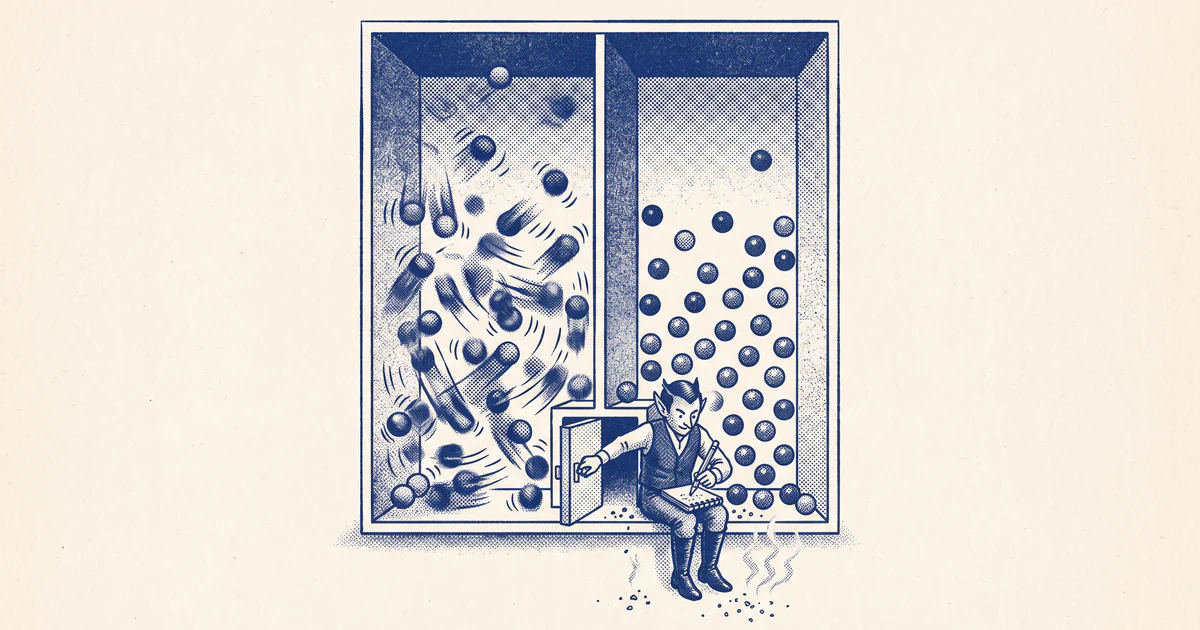
Deleting a bit has a price, paid in heat, and the price is set by the temperature of the room. At 300 kelvin it is about 2.9 × 10⁻²¹ joules per bit. Nobody chose that number. It falls out of the second law of thermodynamics, it has been measured on a glass bead and a single electron and a nanomagnet, and it is the reason a nineteenth-century thought experiment about a tiny doorman took a hundred years to resolve. It is also a number your laptop exceeds by somewhere between four and nine orders of magnitude, which is the part of the story I think gets told least honestly.
§A doorman who breaks the second law
In 1867 James Clerk Maxwell, in a letter to his friend Peter Tait, described a way to beat the second law.[1] Take a box of gas at one temperature and put a wall down the middle with a small door. Station a “finite being” at the door — Maxwell's phrase; Kelvin later called it a demon — who watches the molecules coming. Fast ones heading left, open the door. Slow ones heading right, open the door. Everything else, keep it shut. After a while the left side is hot and the right side is cold, and you can run a heat engine off the difference. No work has been done on the gas. The door is frictionless. Entropy has gone down.
The second law is the most trusted statement in physics, so everyone assumed there was a catch, and the history of the next century is a series of people locating it in the wrong place. One early, influential answer was that the demon has to see the molecules, seeing means bouncing light off them, and the light costs energy. That turns out to be a fact about one way of measuring, not a law. The real catch is subtler and much stranger. It is not in looking. It is in forgetting.
§One molecule, one bit, one piston
Leo Szilard stripped the problem down in 1929. Forget a whole gas; take one molecule in a box at temperature . Slide a partition into the middle. The molecule is now on the left or on the right — one bit of information, if you look. Once you know which side, turn the partition into a piston and let the molecule push it outward, isothermally, drawing heat from the surroundings, until it fills the whole box again. The work it does is the ideal-gas integral for one molecule:
Then repeat. Each cycle turns of heat from a single reservoir into work, which is exactly what the second law forbids. The only thing you spent was one bit of knowledge per cycle. Szilard's engine is the demon reduced to its accounting: one bit is worth of work, at most, and if the bit is free, so is the energy.
This is the first place where I find the subject genuinely disorienting. The ln 2 is not a coincidence or a fudge. It is the logarithm of the number of possibilities you ruled out by looking. Knowledge of which half of a box a molecule is in has a definite exchange rate with joules, and that rate is set by nothing but temperature.
§The bill comes due when you forget
The resolution took two people and about twenty years. In 1961 Rolf Landauer, at IBM, argued that any logically irreversible operation — one where you cannot reconstruct the input from the output — must dump a minimum amount of heat into the environment.[2] The canonical example is erasure: “reset this bit to 0, whatever it was”. Before, the bit could have been in two states; after, it is in one. Its entropy has dropped by . The second law says total entropy cannot fall, so at least that much has to go somewhere else, and for a memory in contact with surroundings at temperature , that means heat:
That is about 0.018 electronvolts. In 1982 Charles Bennett used this to put the demon away.[3] He showed that the measurement step can, in principle, be done reversibly, with no minimum cost at all — which is why the light-costs-energy story was a red herring. But a demon that keeps sorting must keep recording, and a finite memory fills up. To carry on, it has to erase old records, and each erasure pays at least , exactly cancelling the work Szilard extracted. The second law survives. The demon does not get caught looking. It gets caught clearing its cache.
I want to be honest about the status of this, because the clean version is usually presented as more settled than it is. Landauer's principle has had serious critics, mainly philosophers of physics who argue the standard derivations either assume what they set out to prove or are trivially true. Bennett's own response concedes that the principle is, at bottom, a restatement of the second law and defends it on the grounds that it is a useful one. I think he is right, and I also think “restatement of the second law” is a more accurate tagline than the breathless “information is physical”, which tends to suggest that every act of knowing has a price. It does not. Measuring can be free. Copying onto a blank can be free. The unavoidable cost is in destroying the distinction between two states.
§Weighing a single bit
For decades this was all on paper, because 10⁻²¹ joules is far too small to measure in anything resembling a computer. Then experimenters built memories that were nothing but the bit.
In 2012 Antoine Bérut and colleagues trapped a single silica bead, two micrometres across, in water, in a double-well potential made by flicking a laser between two spots about a micrometre apart.[4] Left well is 0, right well is 1. To erase, they lowered the barrier between the wells, gently pushed the bead toward one side by tilting the potential, and raised the barrier again, so that whatever its starting state, it ended in the same well. Tracking the bead's position let them compute the heat dissipated, trajectory by trajectory. The average approached as the erasure was done more slowly, and their data fitted
where is how long the erasure took. Put in numbers and you can see the speed tax. At s the expected heat is about 0.69 + 1.63 ≈ 2.3 kT, more than three times the floor. At 40 s it is 0.69 + 0.20 ≈ 0.9 kT. The Landauer limit is only reached in the limit of infinitely slow operation. Fast forgetting costs extra, and this bead, which takes seconds to forget one bit, is still paying a visible premium.
The inverse experiment — getting work out of information — came in 2014, when Jonne Koski and colleagues in Finland built a Szilard engine out of a single electron in a tiny metal box at around 0.1 kelvin.[5] Measuring where the electron sat and adjusting a voltage in response, they extracted an average of about 0.75 per cycle. At 0.1 K, that is under 10⁻²⁴ joules. A demon, built on purpose, running at three-quarters efficiency.
And in 2016 a Berkeley group did it with something closer to real storage: nanomagnets, the same physics as a hard-drive bit, reset at room temperature.[6] They measured (4.2 ± 0.9) zeptojoules dissipated, about (1.0 ± 0.22) kT, against a Landauer limit of 2.8 zJ, and reported it as consistent with the bound within their uncertainties. That is the minimum price, paid on a bit you could plausibly build a memory out of.
§Your laptop is not paying the Landauer price
Here is where the popular version goes wrong. Landauer's limit is often mentioned as if it were the reason computers get hot, or the wall chips are about to hit. Neither is close to true. Take the figures from a 2023 survey of CMOS energy costs and divide each by 2.9 × 10⁻²¹ J:[7]
Real hardware sits four to nine orders of magnitude above the floor, depending on what you count. For scale: at the Landauer limit, wiping an entire terabyte, 8 × 10¹² bits, would cost about 2 × 10⁻⁸ joules. Reading about 600 bytes out of DRAM costs more than that.
More to the point, almost none of a chip's heat is the Landauer cost at all. A CMOS gate dissipates energy because it charges and discharges the capacitance of its transistors and wires every time it switches, and that loss happens whether or not the operation is logically reversible. An inverter, which loses no information, heats up roughly as much as an AND gate, which does. Wires are worse than logic: on the same table, moving a bit across a chip costs more than switching a gate. The heat coming off your GPU is overwhelmingly the cost of shoving charge around quickly, not the thermodynamic price of forgetting.
So Landauer's principle is a floor, not a forecast. The same survey estimates that conventional CMOS has maybe a couple of hundred-fold efficiency left before it hits its own practical limits, and those limits sit well above , because reliable bits need energy barriers tall enough that heat does not flip them at random. Getting down to the true floor would require computing reversibly, never discarding information, and doing it slowly — which is what the reversible-computing people have argued for decades.[8] It is a real research programme. It is not what is in your pocket.
None of that makes the principle less remarkable. A thought experiment about sorting molecules, a one-molecule engine, and an argument about resetting memory converge on a single expression, , and then a glass bead in a laser beam confirms it to within error bars. What I would push back on is the idea that the number explains anything about the machines we use. It tells you that forgetting can never be free. It says almost nothing about why forgetting, in practice, is a hundred million times more expensive than it needs to be. That gap is an engineering problem, and a much more interesting one than the demon.
- ^A good modern history and review is Juan M. R. Parrondo, “Thermodynamics of Information” (2023), which starts from Maxwell's 1867 thought experiment and works forward to the non-equilibrium treatment used today.
- ^Rolf Landauer, “Irreversibility and Heat Generation in the Computing Process”, IBM Journal of Research and Development 5, 183–191 (1961). His own phrasing was a heat generation “of the order of kT” per irreversible function; the ln 2 is the precise version for one bit.
- ^Charles H. Bennett, “Notes on Landauer's principle, Reversible Computation and Maxwell's Demon”, Studies in History and Philosophy of Modern Physics 34 (2003). He answers the critics directly and concedes the principle is, in essence, a restatement of the second law.
- ^A. Bérut et al., “Experimental verification of Landauer's principle linking information and thermodynamics”, Nature 483, 187–189 (2012). The bead size, trap and the fit ⟨Q⟩ = ln 2 + B/τ with B ≈ 8.15 kT·s are from the authors' longer write-up, “Information and thermodynamics: experimental verification of Landauer's erasure principle” (Bérut, Petrosyan and Ciliberto, 2015).
- ^J. V. Koski, V. F. Maisi, J. P. Pekola and D. V. Averin, “Experimental realization of a Szilard engine with a single electron”, PNAS 111, 13786 (2014).
- ^J. Hong, B. Lambson, S. Dhuey and J. Bokor, “Experimental test of Landauer's principle in single-bit operations on nanomagnetic memory bits”, Science Advances 2, e1501492 (2016).
- ^Anson Ho, Ege Erdil and Tamay Besiroglu, “Limits to the Energy Efficiency of CMOS Microprocessors” (2023), Table I. The authors note the figures vary with hardware and task; the ratios to kT ln 2 are my arithmetic.
- ^Michael P. Frank, “Back to the Future: The Case for Reversible Computing” (2018).