The Quantum Measurement Paradox: Why Reality Doesn't Exist Until We Look at It
Physics14 min
The title of this piece is wrong, and I want to be precise about how, because the way it is wrong is more interesting than the way it is usually told. Nothing in quantum mechanics waits for a person to look. Particles do not check whether a grad student is in the room. But after you strip the mysticism off, what remains is not tamer. It is a result, tested to the point of a Nobel Prize, that the world does not carry around pre-written answers to every question you could ask it.
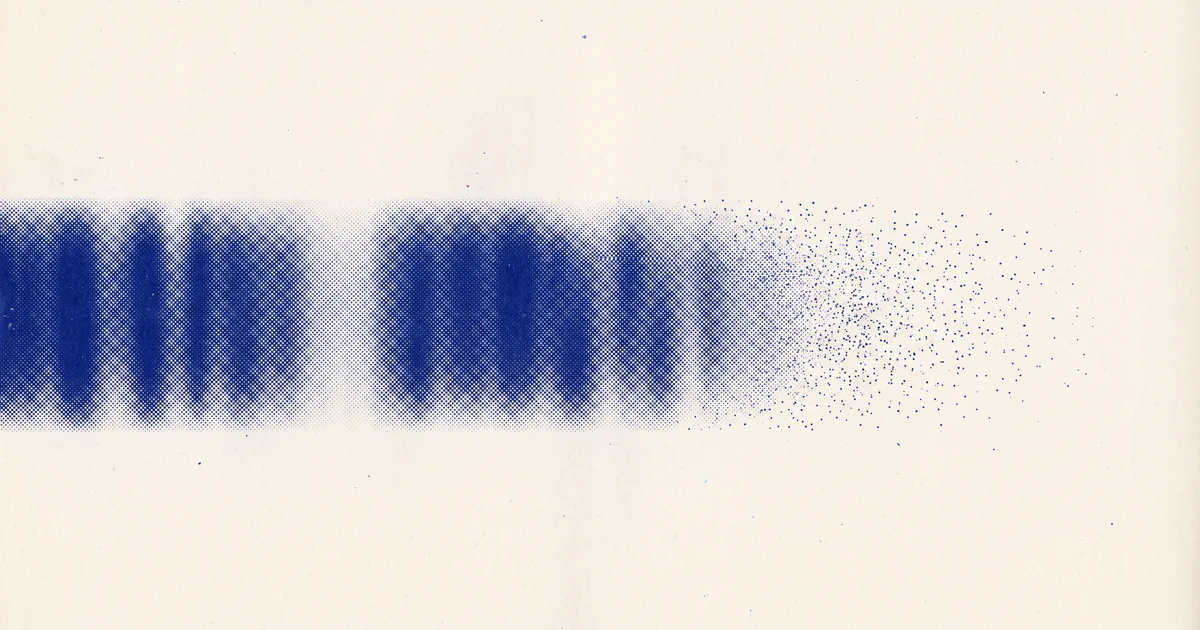
Start with the version everyone has heard. Fire electrons one at a time at a wall with two slits. Each one lands as a single dot on the screen behind, like a particle. But let thousands accumulate and the dots arrange themselves into stripes, the signature of a wave that went through both slits and interfered with itself. Now put a detector at the slits to see which one each electron used. The stripes vanish. You get two plain blobs, one behind each slit.
The pop-science gloss is that the electron "knows it is being watched." That sentence has done more damage to public understanding of physics than any other I can think of, because it smuggles in the one ingredient the experiment never needed: a mind.
§The detector does not need to be awake
Here is what actually kills the stripes, in one line of algebra. Call the part of the electron's wavefunction that goes through slit A and the part through slit B . With no detector, the probability of landing at position is the squared magnitude of their sum, and squaring a sum produces a cross term. The cross term is the stripes.
Now let the electron interact with something on its way through, a stray photon, a gas molecule, a detector. That something ends up in state if the electron took slit A and if it took slit B. The pattern on the screen becomes:
Everything interesting lives in that last factor, , the overlap between the two possible states of whatever the electron touched. If the marker ends up the same either way, the overlap is 1 and you get full stripes. If the two marker states are perfectly distinguishable, the overlap is 0 and the stripes are gone. In between, you get washed-out stripes. No observer appears anywhere in the equation. What matters is whether the path has been recorded in the physical state of anything at all, whether or not anyone ever reads the record.
This is decoherence, and it is the most underrated idea in the whole conversation. The environment is a relentless note-taker. Air molecules bounce off things; things emit heat. Every one of those interactions writes a little which-path information into the world, and once it is written, interference between the alternatives is effectively unrecoverable. A cat is not in a visible superposition of alive and dead for the same reason a falling glass does not unshatter. It is not forbidden. The bookkeeping is just hopeless.
My favourite demonstration of this involves no human witness at all. In 2004, Markus Arndt's group in Vienna sent C70 fullerene molecules, little footballs of seventy carbon atoms, through an interferometer, and heated them on the way.[1] A hot molecule glows, emitting thermal photons. Each photon carries a faint trace of where the molecule was when it left. The hotter the molecules, the more photons, the more the fringes faded, in good agreement with decoherence theory. The molecules were, in effect, observing themselves by giving off light into an empty vacuum chamber. That is all "observation" ever meant.
And the flip side is just as telling. Keep things isolated enough and the stripes come back for objects that have no business being wavy. The same group has since shown interference with gramicidin, a natural antibiotic built from fifteen amino acids. The line between quantum and classical is not a size. It is a question of how loudly a thing is talking to its surroundings.
§The eraser that erases nothing in the past
If decoherence were the whole story, the measurement problem would be a footnote. The reason it is not is a family of experiments that look, at first glance, like the future reaching back to rewrite the past. The most famous is the delayed-choice quantum eraser, run by Kim, Yu, Kulik, Shih and Scully and published in 2000.[2]
The setup, compressed: a photon passes through a double slit and then a crystal splits it into an entangled pair. One photon, the signal, goes straight to a screen detector called D0. Its twin, the idler, takes a longer route, roughly 2.5 metres longer, so it arrives about eight nanoseconds after the signal photon has already landed. On that longer route, beam splitters send the idler randomly to one of four detectors. If it ends up at D3 or D4, its arrival tells you which slit the pair came from. If it ends up at D1 or D2, the paths have been mixed so that the which-path information is gone. Erased.
Here is the result that launched a thousand YouTube thumbnails. Take the signal photons whose twins landed at D1 and plot where they hit D0: stripes. Do the same for D2: stripes. For D3 and D4: no stripes. The idler's fate was decided after the signal photon was already recorded, so it looks as if a later choice determined whether an earlier photon behaved like a wave or a particle.
Now look at the raw data at D0 without sorting. There are no stripes. There never are. D0 alone shows a featureless smear in every run, regardless of what happens to the idlers. The stripes only exist inside subsets you can carve out after the fact, by matching each signal photon to its twin with a coincidence counter, and to do that matching you need the idler records, which arrive by ordinary, slower-than-light means.
The trick that makes it all consistent is that the two "erased" patterns are mirror images. If the D1 subset goes as , the D2 subset goes as , a half-wave shifted, peaks where the other has troughs:
Add them and the stripes cancel into the same blob you started with. Sean Carroll's write-up of this makes the point well: the measurement on the idler is not reaching back and changing anything, it is choosing which way to slice an entangled state that was always there, and some slicings reveal interference.[3] If you were standing at D0 trying to receive a message from the future, you would see nothing until someone mailed you the idler logs. At that point the message has arrived the boring way.
So the retrocausal reading is simply wrong, and I think it is worth being impatient about it. But the experiment still teaches something real, and the follow-ups sharpen it. In 2007, a team including Alain Aspect realised Wheeler's original delayed-choice thought experiment with single photons, choosing whether to open or close the interferometer with a quantum random number generator after the photon had already entered. In 2013, Anton Zeilinger's group ran a quantum eraser in which the choice to erase or keep which-path information was made 144 kilometres away, in a region no signal from the interference measurement could have reached in time.[4]
What these experiments kill is not causality. They kill the story where the photon, at the slits, "decides" to be a particle or a wave and carries that decision forward like a label. There was no label. "Which slit did it go through?" is not a fact sitting quietly in the past waiting for us to read it. It is a question whose answer depends on what else in the experiment gets measured, and how.
§Where consciousness snuck in
If the physics never needed a mind, how did the mind get into the story? Not, as is often claimed, through Niels Bohr. Bohr insisted that measuring apparatus be described in classical terms so that results could be communicated unambiguously, and he treated the wavefunction as a symbolic tool rather than a physical thing that could collapse. The idea of consciousness as the final link entered through John von Neumann's formal treatment of measurement, which pushed the moment of collapse all the way up to the observer's subjective perception, and later through Eugene Wigner, who explicitly proposed that the mind causes it. The "Copenhagen interpretation" itself was never one coherent doctrine. The label was popularised partly by its critics, and Bohr and Heisenberg never fully agreed on it.[5]
Decoherence made the consciousness reading look not just unnecessary but faintly ridiculous. If a heated molecule decoheres in an empty vacuum chamber, the boundary between quantum and classical is clearly being drawn by physics, not psychology.
But decoherence does not finish the job, and this is the part pop accounts almost always skip. Decoherence explains why you never see a superposition of measurement outcomes. It does not explain why you see an outcome. After the environment has done its note-taking, the electron-plus-detector-plus-room is, according to the Schrödinger equation, still one big superposition, just one in which the branches can no longer interfere. Why you find yourself in one branch, with one dot on the screen, is the measurement problem in its honest, narrowed form.[6]
§Choosing which bill to pay
Every interpretation of quantum mechanics is a way of paying for that gap. None of them is free, and I distrust anyone who presents their favourite as obviously correct.
Copenhagen, in its working-physicist form, refuses the question. The wavefunction is a tool for predicting measurement results; asking what is "really" happening between measurements is a category error. This is honestly how most quantum engineering gets done, and it works. The bill is that it never tells you where the cut between quantum system and classical apparatus goes, or why there should be one.
Many-Worlds takes the Schrödinger equation at its word and never collapses anything. Every outcome happens; decoherence carves the universal wavefunction into branches that cannot see each other, and you are in one of them. It is the most economical theory on paper: one equation, no special measurement rule. The bill is probability. If every outcome occurs, what does it mean to say one outcome has a 70% chance? There are serious proposals, built on self-locating uncertainty or decision theory, and none is accepted as settled.[7]
Pilot-wave theory, from de Broglie and Bohm, says the electron always has a definite position and is guided by the wave, so it goes through exactly one slit while the wave goes through both. The bill is explicit nonlocality: the guiding wave connects distant particles instantly, even if that connection cannot be used to send signals. Objective-collapse theories such as GRW go the other way and modify the Schrödinger equation so that superpositions spontaneously collapse, rarely for a single particle and overwhelmingly fast for anything macroscopic. The bill is new physics that nobody has yet seen, though in fairness, that makes them testable in principle, which is more than the others can claim.
My own position, for whatever an engineer's position is worth: I find Many-Worlds the most intellectually clean and the least satisfying, and pilot-wave the most intuitive and the most suspicious. I do not think the experiments currently force a choice, and I think that is the actual scandal. Not that reality depends on looking, but that a century in, we have a theory that predicts everything we measure and still disagree about what it describes.
§The part that really is weird
If I have spent this whole piece deflating the title, here is where it earns some of its keep. There is one result that genuinely says the world does not hold definite, local answers to questions before you ask them, and it is not the double slit. It is Bell's theorem.
The setup: two entangled particles fly apart. Two experimenters, far away from each other, each choose one of two measurement settings at random and record a result of +1 or −1. Combine the correlations from the four setting pairs into a single number:
If each particle carried its answers with it from the start, a hidden instruction sheet saying "if measured at setting a, say +1", and if neither experimenter's choice could influence the other side in time, then a few lines of arithmetic prove that . Quantum mechanics predicts values up to . There is no interpretive wiggle room here. It is a number you measure, and it either breaks 2 or it does not.
It breaks 2. For decades the experiments had loopholes: detectors that missed too many particles, or settings chosen close enough in time that a signal could, in principle, have leaked across. In 2015 a team at Delft closed both at once, entangling electron spins in diamond 1.3 kilometres apart, and measured over 245 trials, with a p-value of 0.039.[8] That is not a huge statistical margin on its own, but it sits on top of decades of experiments pointing the same way. In 2022 the Nobel committee gave the physics prize to Aspect, Clauser and Zeilinger for establishing the violation of Bell inequalities with entangled photons.[9]
What exactly is ruled out? Local hidden variables: the combination of "outcomes are fixed in advance" and "nothing travels faster than light." You can keep one. Pilot-wave theory keeps definite values and gives up locality. Many-Worlds keeps locality, on most readings, and gives up the idea that a measurement has a single outcome. There is also a fringe escape route called superdeterminism, which says the experimenters' "random" choices were correlated with the particles all along; I find it about as satisfying as answering a bug report with "works on my machine."
So the honest version of the title is something like: reality does not come with pre-written local answers. That is a stranger claim than "reality waits for us to look," not a weaker one. The looking version flatters us; it makes the observer the protagonist. The Bell version is indifferent to us entirely. The universe was refusing to hold definite local values long before anything evolved eyes, and the fullerenes decohering in Vienna did not need anyone in the room.
If I could rename one variable in physics, it would be "observer". Call it "anything that ends up correlated with the system" and half the paradoxes stop sounding like ghost stories. The other half, the Bell half, get more interesting, because then you can see that they were never about us.
- ^L. Hackermüller, K. Hornberger, B. Brezger, A. Zeilinger and M. Arndt, Decoherence of matter waves by thermal emission of radiation, Nature 427, 711–714 (2004). For how big these interfering objects have since become, see Shayeghi et al., Matter-wave interference of a native polypeptide (2019), which did it with the 15-amino-acid antibiotic gramicidin.
- ^Y.-H. Kim, R. Yu, S. P. Kulik, Y. Shih and M. O. Scully, A Delayed Choice Quantum Eraser, Phys. Rev. Lett. 84, 1 (2000), based on a 1982 proposal by Scully and Drühl. The detector layout and the ~8 ns delay are laid out clearly in the Wikipedia walk-through, which also has a section on why there is no retrocausality.
- ^Sean Carroll, The Notorious Delayed-Choice Quantum Eraser (2019). The clearest account I have found of where the fringes go when you stop sorting.
- ^V. Jacques et al., Experimental realization of Wheeler's delayed-choice GedankenExperiment, Science 315, 966 (2007); X.-S. Ma et al., Quantum erasure with causally disconnected choice, PNAS 110, 1221 (2013), using a 144 km free-space link.
- ^Stanford Encyclopedia of Philosophy, Copenhagen Interpretation of Quantum Mechanics. The entry is blunt that mind-induced collapse is not Bohr's view, and that "Copenhagen" was never one doctrine.
- ^Stanford Encyclopedia of Philosophy, The Role of Decoherence in Quantum Mechanics; and W. H. Zurek, Decoherence and the transition from quantum to classical — revisited (2003), an update of his 1991 Physics Today article.
- ^Stanford Encyclopedia of Philosophy, Many-Worlds Interpretation of Quantum Mechanics, which gives the probability problem a fair and unresolved hearing.
- ^B. Hensen et al., Experimental loophole-free violation of a Bell inequality using entangled electron spins separated by 1.3 km, Nature 526, 682–686 (2015).
- ^Royal Swedish Academy of Sciences, The Nobel Prize in Physics 2022, awarded to Alain Aspect, John Clauser and Anton Zeilinger.