Titan and Enceladus: Why the Outer Solar System Is Our Best Bet for Alien Microbes
Space1 min
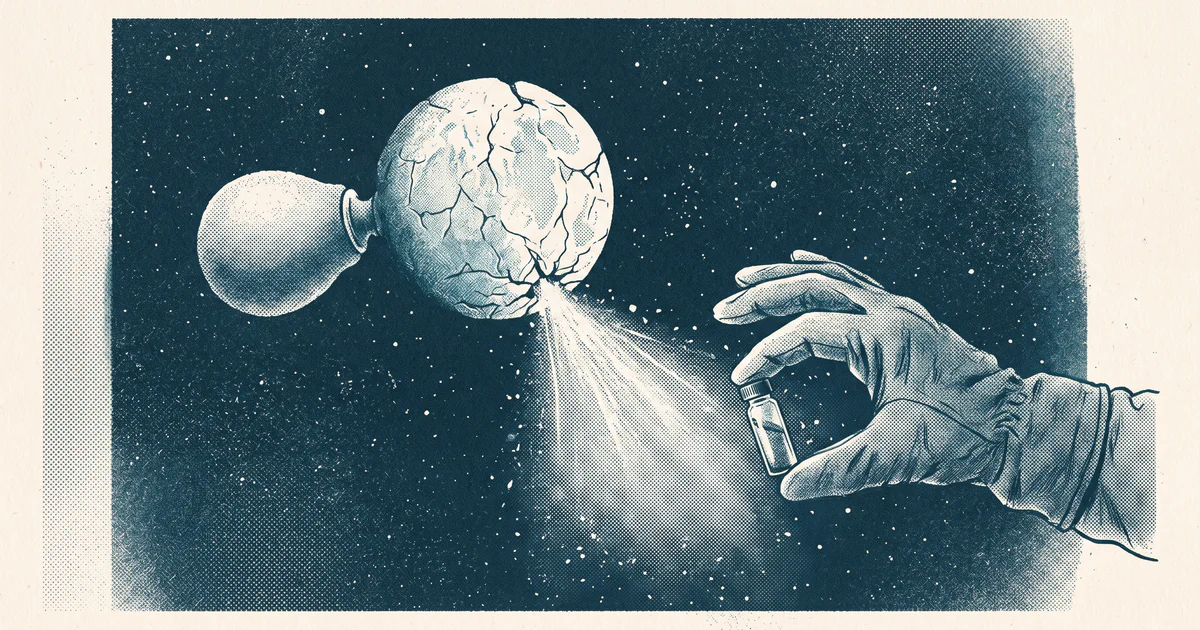
There is a moon of Saturn about 500 kilometres across, a seventh the width of our own Moon, that is spraying its ocean into space from cracks at its south pole. You do not need to land on it, drill through it, or melt anything. You fly through the spray with the right instrument and read what comes out. Cassini did exactly this, more than once, with instruments that were never designed for the job, and what it found is the main reason I think the outer solar system deserves the top of the astrobiology list.
I want to be careful with the title, though, because “forget Mars” is a provocation and not an argument. Mars currently holds the most interesting candidate sign of past life anyone has found off Earth. The case for Saturn’s moons is not that Mars is a dead end. It is subtler and, I think, stronger: an ocean in the outer solar system is the place where a positive result would mean the most.
§Enceladus is an ocean that samples itself
Cassini discovered the jets in 2005. They erupt from warm fractures nicknamed the tiger stripes, where the ice is only about one to five kilometres thick, compared with twenty or so on average.[1] Gravity measurements and a slight wobble in the moon’s rotation showed the water underneath is a global ocean, not a local pocket. And the jets feed one of Saturn’s rings, so the ocean’s contents are smeared along the E ring for a passing spacecraft to collect.
Three Cassini results, spread over eight years, turned that ocean from wet into interesting.
The first was heat. In 2015, Sean Hsu and colleagues showed that tiny silica grains Cassini had been collecting near Saturn came from Enceladus, and that their size, only a few nanometres, could only be explained by water hotter than about 90 °C reacting with rock and then cooling fast. The grains had to have travelled from the seafloor to space within months to a few years, or they would have grown larger.[2] That points to hydrothermal activity on the floor of an ocean in a moon where the surface sits far below the freezing point of anything you would want to drink.
The second was food. On its deepest dive through the plume, on 28 October 2015, Cassini’s mass spectrometer measured molecular hydrogen at about 1% of the gas, alongside carbon dioxide and methane.[3] Hydrogen and carbon dioxide together are a meal. On Earth, microbes called methanogens near hydrothermal vents make their living from exactly this reaction:
Hydrogen should not hang around in an ocean with things that eat it. Finding it escaping means it is being produced, presumably by water–rock chemistry, faster than anything is using it up. Hunter Waite, who led the analysis, called the plume a candy store for microbes, and also said plainly that Cassini could not detect life itself. Both halves of that matter. Free energy sitting unused is consistent with an empty ocean, too.
The third was phosphorus, the element that had been the conspicuous gap. Life as we know it builds DNA, RNA and its energy-carrying molecules on phosphate, and geochemists had argued it might be scarce in icy-moon oceans. In 2023 Frank Postberg’s team found sodium phosphates in ice grains from the E ring, and inferred concentrations more than a hundred times higher than in Earth’s oceans.[4] Salt water, heat, chemical energy, carbon, and now phosphorus. You can argue about the exact abundances. You cannot easily argue that anything on the standard checklist is missing.
What makes this special, rather than just encouraging, is access. Europa almost certainly has an ocean too, under ice many kilometres thick, and getting a sample means either drilling or hoping for plumes that are still contested. Enceladus hands you the sample. From an engineering point of view, it is the difference between reverse-engineering a closed system and reading its logs.
§Titan is a chemistry lab, not a microbe bet
Titan is the other half of the title, and it is a very different kind of place. It is bigger than the planet Mercury. Its atmosphere is about 95% nitrogen and 5% methane, at a surface pressure about 60% higher than Earth’s, roughly what you feel fifteen metres underwater. The surface is about −179 °C, cold enough that water ice behaves like rock. And it is the only place besides Earth known to have stable liquid on its surface: rain, rivers, lakes and seas, made of methane and ethane.[5]
Titan is genuinely astonishing, and it is my weaker bet for microbes, for two reasons. Its surface liquids are not water, and every idea for life in liquid methane is unconstrained speculation; we have no example of biochemistry that works at those temperatures and no strong reason to think it must exist. Titan does seem to have a water ocean too, but Huygens data suggests it lies something like 55 to 80 kilometres below the ice.[5] That is not an ocean that sprays itself into space for you.
Where Titan is unbeatable is chemistry. Sunlight breaks up methane high in its atmosphere, and the fragments recombine into a haze of larger organic molecules that settle onto the surface. The whole moon is a slow, planet-sized experiment in what carbon chemistry does over geological time, without biology getting in the way. That is exactly how NASA pitches Dragonfly: a mission to study the chemistry that came before biology, not to detect life.[6]
Dragonfly is a nuclear-powered rotorcraft, and Titan is perhaps the easiest place in the solar system to fly: thick air and low gravity. It hops between sites every Titan day or two, each one about 16 Earth days long, over a mission of about three years. As of September 2026, NASA had it scheduled to launch in summer 2028 and reach Titan in late 2034. In the same update, the IAU approved a name for the landing region: Ahmakiq Undae, a dune field roughly 810 kilometres across, south of Selk crater.[7] If you want a measure of how long this takes, a child born the week this article was published will be about eight when Dragonfly lands.
§Mars has the best clue and no way to bring it home
Now the fair hearing for Mars, because it has earned one.
In July 2024 Perseverance drilled a core called Sapphire Canyon from a rock called Cheyava Falls, in an ancient riverbed in Jezero crater. The rock is a mudstone with organic carbon in it, and it is covered in small “leopard spots” — reaction fronts carrying two iron minerals, vivianite and greigite. On Earth those minerals commonly form when microbes break down organic matter. They can also form without life, at high temperatures or in acidic conditions, and the rocks show no sign of either. The paper went into Nature in September 2025. The project scientist’s summary is the right one: abiotic explanations are less likely, but “we cannot rule them out.”[8]
That is the strongest candidate biosignature anyone has. And it is sitting in a sealed tube inside a rover, because the mission that was supposed to fetch it is gone. The fiscal 2026 budget that Congress passed in January did not support NASA’s existing Mars Sample Return programme, after years of cost growth.[9] The samples might come back someday, under some other plan. For now, the single most promising piece of evidence for life beyond Earth is in a test tube on another planet with no ride home.
So I am not arguing Mars is uninteresting. I am arguing two things about it. First, any Martian life we find is likely long dead, a fossil signature in a rock several billion years old, and fossil evidence of microbes is notoriously hard to make airtight even on Earth, where we can hold the rock. Second, Mars and Earth have been swapping rocks the whole time: meteorites knocked off Mars have landed here. If we found ancient Martian microbes that looked like ours, we could not easily tell a second origin of life from a shared one carried across on debris.
§Why a second genesis is worth more than a first fossil
This is the actual argument for the outer solar system, and it is less about likelihood than about what an answer would teach us.
A living microbe in Enceladus’s ocean would be present tense. You could, in principle, look at its chemistry directly: which molecules it uses, which mirror-image forms it prefers, whether its building blocks match ours. Saturn is far enough away, and ejecting rock from it to Earth hard enough, that a match would be surprising and a mismatch would be decisive. Find life with a different biochemistry in a small ocean that has nothing to do with ours, and you have learned that life starts easily wherever the conditions allow. That is the biggest question in the field answered with a sample size of two, from independent draws.
Mars could, in principle, give you that too. But you would have to get the rock home, show it was biological, and then show it was not a relative. Enceladus skips the first and third problems and only leaves the hard one in the middle.
The awkward part is the schedule. No mission currently in development will sample Enceladus. ESA’s fourth large mission is under study as an Enceladus orbiter and south-polar lander, launching around 2042.[10] Dragonfly, the only mission actually being built for Saturn’s moons, is a chemistry mission. Add the long cruise to Saturn, and if you are impatient for a direct test of life in an ocean, the honest answer is probably the 2050s.
§What would change my mind
I said this was a bet, so here is what would make me move it.
If Sapphire Canyon, or something like it, came back to a lab on Earth and the case for biology became overwhelming, Mars would retake first place immediately. A confirmed second origin would be worth more than any amount of promising chemistry elsewhere, even if we could never fully rule out a shared ancestor. Fossils settle “did it happen” even when they cannot settle “how many times.”
On the other side, if a future plume mission found Enceladus’s ocean chemically rich but stubbornly at equilibrium, with no sign of the gradients that life tends to leave behind, I would treat that as real evidence that habitable does not mean inhabited. That would be a disappointing result and a scientifically valuable one. It would tell us the checklist we use to rank worlds is missing something.
Until then, here is where I land. Mars is where we have the best clue. Enceladus is where we would get the cleanest answer. Titan is where we learn what chemistry does before anyone is watching. If I could fund one mission tomorrow, it would be the one that flies through the spray again with instruments built for the job — and the one I would least like to see cancelled is whatever eventually brings Cheyava Falls home.
- ^NASA, Enceladus: about 500 km across; the ice is roughly 20–25 km thick on average and 1–5 km at the south pole.
- ^NASA JPL, Spacecraft Data Suggest Saturn Moon’s Ocean May Harbor Hydrothermal Activity (March 2015), on S. Hsu et al., Nature 519, 207 (2015).
- ^Johns Hopkins APL, Chemical energy critical to life found on Saturn’s moon Enceladus (April 2017), on J. H. Waite et al., Science 356, 155 (2017).
- ^Freie Universität Berlin, New Discovery of Phosphorous in the Subsurface Ocean of Enceladus (June 2023), on F. Postberg et al., “Detection of phosphates originating from Enceladus’s ocean,” Nature 618, 489 (2023).
- ^NASA, Titan: Facts.
- ^NASA, Dragonfly mission page, which lists launch no earlier than July 2028.
- ^NASA, NASA’s Dragonfly Gets Wired Up While Titan Landing Area Is Named (2 September 2026). Dragonfly was originally meant to launch in 2026; the date has slipped more than once.
- ^NASA, NASA Says Mars Rover Discovered Potential Biosignature Last Year (10 September 2025), on J. Hurowitz et al. in Nature.
- ^The Register, Congress throws NASA a lifeline, leaves Mars sample mission to die in the dust (January 2026).
- ^ESA, L4 to Enceladus: under study, launch listed as 2042, on two Ariane 6 rockets.